-
Straightening the Crooked Horse: What’s your Horse’s Asymmetry?
As with people, horses often tend to be slightly asymmetric. However, many riders don’t realize that challenges they face in their riding can often develop from issues with the horse’s straightness, stemming from this asymmetry. Issues such as the horse pushing in or out in one direction, being heavy on one rein, having trouble picking up one canter lead, or…
-
Combining Steinbrecht’s Critiques with Baucherist Riding
As an outspoken critic of François Baucher’s work, Gustav Steinbrecht described his critiques of Baucherism in his classic book, The Gymnasium of the Horse, as he advocated for following the training methods of the Old School. While both horsemen lived in the 19th century, Baucher and Steinbrecht had quite different approaches to training the horse – with Baucher seeking lightness…
-
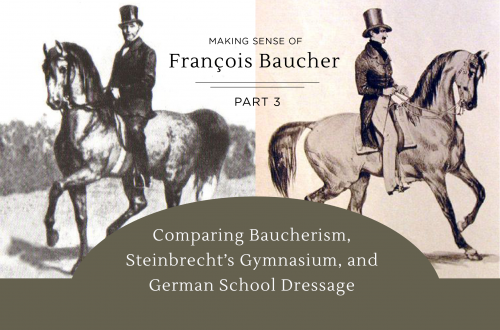
Making Sense of Baucher Part 3: Comparing Baucherism, Steinbrecht’s Gymnasium, and German School Dressage
François Baucher’s training methods brought a unique system of developing a horse in lightness, yet his techniques countered some of the fundamental, prevailing ideas of horse training in his time. His methods continue to offer a philosophy that at times significantly differs from German School riding that we now see most commonly in dressage. This has led to quite a…
-
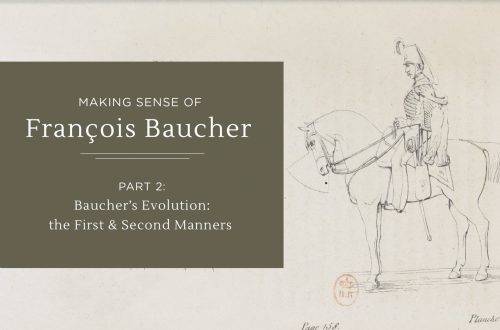
Making Sense of Baucher Part 2: Baucher’s Evolution
Over his career, François Baucher refined his methods considerably. But while his earlier work (the first manner) became quite well known, his second manner, which first appeared only in the 12th edition of his New Method of Horsemanship, sadly didn’t achieve the same reach. Thus, there’s sometimes some vagueness about his philosophy and methods, as it can be easy to find only his first manner…
-
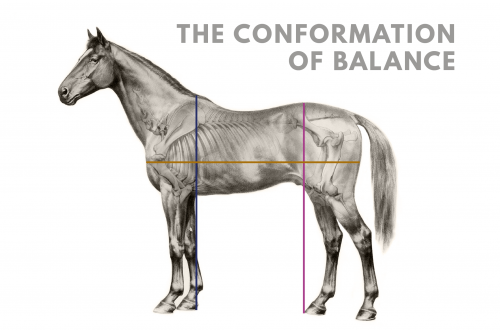
The Conformation of Balance
I don’t know about you, but I remember learning conformation as being very complicated. There can be endless diagrams, angles to analyze, triangles and squares to visualize, and various different methods of analysis. But really when it comes down to it, all that matters most to us as riders is how a horse’s conformation will impact its movement, our riding,…
-
Making Sense of Baucher Part 1: The Principles and Philosophy of Baucher
An influential horseman who brought a new philosophy of riding in lightness, François Baucher worked to develop a system of training to bring any horse into balance. The author of the now often-quoted principle of “hands without legs, legs without hands,” and whose work greatly influenced the riding of horseman Nuno Oliveira, Baucher was in fact a highly controversial figure…
-
Why Aren’t Riding Stallions More Common in North America?
Learning to ride in the Pacific Northwest of Canada, there were very few stallions around. I remember meeting maybe four stallions in all the riding schools I ever visited, all of which were privately owned. Even today, stallions are quite uncommon in the average riding stable, and can sometimes be seen as unwelcome or complicated additions. Across North America, stallions…
-
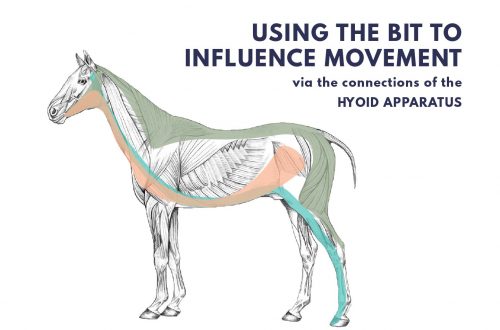
The Benefit of Using Bits | The Hyoid Connection
A well-trained horse with a skilled rider can often perform some of the most complex movements without saddle or bridle, their skill surpassing any need for specific equipment. Riders like Alizée Froment demonstrate exactly this – that communication depends on the skill of horse and rider much more than on any specific tools. And with increasing interest in bitless riding…
-
Do I Need a Noseband? On the Purpose of Nosebands.
Growing up riding in the hunters and jumpers, I remember looking at western bridles and thinking, “Where’s the noseband?” and “How can people ride without a noseband?” Having always used bridles where the noseband was an integral part, I couldn’t understand how or why people would do without them – although I didn’t even really know why I used them.…
-
Leading Horses From the Inside Out
Many people have different ideas about what our relationship with horses should look like. While some horse people still advocate for “being the boss” and establishing dominance, others have shifted away from this idea, and aim to act more as a friend rather than a boss, building trust through soft and sensitive requests. There are interesting merits and limitations to…